Sharing OU’s Journey to Improve Anonymous Ethics and Compliance Reporting

By Carolyn Clink
Anonymous ethics and compliance reporting programs are a critical component of institutional governance in higher education, yet their effectiveness depends on far more than awareness alone. Posters, training reminders, and website links may create visibility, but utilization is ultimately shaped by trust in the system, clarity of the reporting process, and the institution’s follow-through once a concern is raised.
Over the past five years, the University of Oklahoma (OU) undertook a series of incremental but deliberate enhancements to its anonymous reporting hotline and case management practices that collectively strengthened utilization, improved the experience for reporters and case managers, and produced more reliable data for oversight and improvement. The results offer a practical example for institutions seeking to move beyond awareness toward sustained performance.
Enhancing the Hotline Intake Process
OU transitioned from a single general intake site launched in 2016 to campus‑branded “Report It!” sites in 2021 and expanded the program to all system campuses. Although branding may appear primarily visual, it also serves to reassure users that the reporting site is an official institutional channel, which can enhance credibility and encourage reporting. Ease of access can be the difference between a completed report and an abandoned attempt. OU improved usability through the addition of mobile reporting access, streamlined intake questionnaires, and automatic system responses which allowed reporters the comfort that their complaint was being addressed.
One of the most common friction points in hotline intake is asking reporters to choose from an overwhelming list of reporting categories. OU reduced its issue types from 46 to 26, aiming to make selection faster and more consistent. Better taxonomy helps reporters spend less time guessing where their issue fits and also benefits case managers with clearer issue routing. OU also refined issue categories to better align with institutional risk areas.
OU added process overviews and resource links directly to the intake sites. This created a more transparent reporting pathway by giving users additional context about how the process works and where to find related support resources. In 2025, OU also added a detailed “Your Obligations as a Reporter” statement to the websites, reinforcing expectations around good faith reporting, non-retaliation, and the consequences of false reporting. This type of clarity can reduce misuse while strengthening confidence in the integrity of the process.
With the reporting process easier to navigate, OU focused next on ensuring students, employees, and other stakeholders knew when and how to use it.
Awareness Efforts
Intake improvements were paired with sustained awareness efforts for the Report It! program rather than initiating a one‑time launch. Highlights across the timeline included:
- 2021 enhancement launch: posters, a presidential mass email, an internal newsletter article, and integration into manager orientation.
- 2022 refresh: adding digital signs and improving poster placement through walkthroughs and public-space targeting.
- 2023–present: collaboration with enterprise risk stakeholders to meet specific group needs.
- 2024–2025: expansions into student-facing channels, including wallet cards at events, move-in initiatives, arena signage, tabling, and training touchpoints.
Over time, awareness efforts were implemented through successive outreach activities tailored to different campus settings, audiences, and communication channels.
Case Handling Improvements
Enhancing awareness and the reporter experience, however, represented only half of the effort. The second half is ensuring the internal system supports consistency, speed, and reliable outcomes. OU’s enhancements for case managers included:
- Reducing duplication in questionnaires and data capture.
- Clarifying definitions and aligning stakeholders on issue type meaning.
- Adding search functionality to find and manage cases more efficiently.
- Single sign-on to reduce access friction.
- Training for subject matter experts after software enhancements.
- Expansion of functional add-ons, including a Clery Act CSA reporting tool in 2024.
These changes positively affected cycle times, documentation quality, and reporting consistency, which influenced reporter confidence in the overall process.
To further support consistency, OU formalized case management standards with clear timelines and required documentation. Cases were assigned within 24 hours, status updates were expected within two business days, and post-closure follow-up was required. Defined case closure protocols and required data fields, including outcome, action taken, Clery indicators, and synopsis notes, were established to improve comparability across cases and time periods. OU also established a five-business-day post-closure period during which reporters may provide clarification or supplemental information, which is particularly valuable for anonymous reports that initially lack sufficient detail for investigation.
These standards enabled more reliable monitoring, reporting, and benchmarking and reduced variability that can undermine KPI analysis.
KPIs and Benchmarking
With structured data in place, OU developed a KPI framework that examined both intake and outcomes. Key metrics included:
- Intake volume by campus and issue type
- Intake method
- Anonymous reporting rate
- Open versus closed case counts
- Average case closure time
- Substantiation rate
- Outcomes and actions taken
- Anonymous follow-up rate
These metrics supported internal monitoring, transparency with senior leadership and the Board of Regents, and continuous improvement discussions with subject matter experts. Importantly, metrics were used as management tools rather than static scorecards, enabling conversations about awareness, investigative effectiveness, policy clarity, and organizational culture.
One notable KPI goal was to reduce the number of anonymous reports. This sounds like the opposite of what a hotline program desires. A consistently high anonymous rate may suggest concern about retaliation, limited trust, or uncertainty about the reporting process. OU’s rationale was aligned with mature program thinking. Named reporters tend to be more engaged, and increased trust often reduces the perceived need for anonymity. Additionally, better collaboration with the reporter supports faster resolution and increased trust.
Once consistent metrics were in place, the program moved from basic volume tracking to broader questions about patterns, policy implications, and preventive action. OU’s reporting and analysis approach supports:
- Trend analysis and risk identification
- Targeted recommendations for program improvements
- Better governance reporting for transparency
- Reinforcement of behavioral expectations (e.g., recommendations for improved employee civility expectations; student antibullying and social media expectations)
- Feedback loops into academic units to monitor follow-through and actions taken
This way hotline programs can contribute to institutional value: by addressing individual cases while also informing policy, systems, and culture over time.
Results of the Improvements
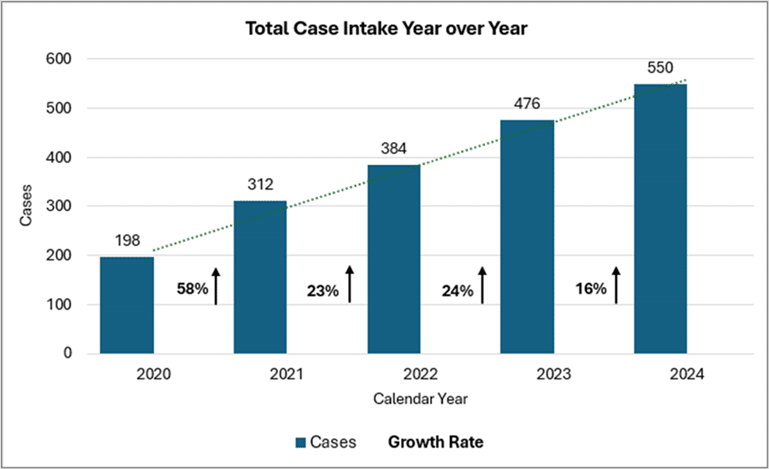
The cumulative impact of these enhancements was measurable. Case intake increased in each reporting period reviewed, with growth of 58 percent from 2020 to 2021, 23 percent from 2021 to 2022, 24 percent from 2022 to 2023, and 16 percent from 2024 to 2025. Viewed collectively, these trends suggest that coordinated improvements to intake design, awareness, and case management can support sustained utilization rather than temporary spikes.
In addition to increased volume, the quality and disposition of reports provided further insight into program effectiveness. In calendar year 2024, 55 percent of hotline reports contained sufficient information and/or reporter engagement to support an investigation, representing 303 cases investigated to resolution. Thirty-five percent of reports lacked sufficient information to resolve the matter, while the remaining 10 percent were either referred outside the University or determined to be frivolous. These results highlight both the value of increased utilization and the continued importance of enhancing report quality and reporter engagement.
Over time, improved data allowed OU Internal Audit to analyze trends and make recommendations to management to refine policies such as employee civility and student conduct expectations, and to provide more targeted feedback to academic and administrative units.
OU’s ongoing efforts also include a focus on consolidated incident reporting across disparate systems, with stakeholders working to cross-reference data and report consistent KPIs across platforms so stakeholders can compare trends, strengthen management visibility, and identify emerging risks more consistently.
Key Takeaways for Higher Education Programs
For institutions reviewing anonymous reporting programs, OU’s experience highlights the following practical considerations:
- Simplify intake – Reduce friction, clarify categories, and add clear guidance.
- Support trust – Branding, transparency, and follow-through can influence whether individuals report.
- Fix the internal workflow – Case manager experience shapes speed, consistency, and data quality.
- Standardize case handling – Clear timelines, definitions, and required closure fields improve consistency and reporting quality.
- Use KPIs that inform action – Metrics are most useful when they support operational and governance decisions.
- Plan for cross-system visibility – Multiple reporting platforms require stronger coordination over time.
For higher education institutions, anonymous reporting systems are most effective when usability, process discipline, and performance measurement are addressed together. OU’s experience suggests that incremental operational changes can improve both utilization and consistency over time.